As a professional solar panel cleaning service team working with agricultural clients every day, we see firsthand how rapidly dirt impacts energy production.
Farm environments punish equipment in ways city environments never could.
That 680-acre row crop operation generates enough airborne debris to smother an expensive array in weeks.
We will break down the true cost of this buildup and walk through the specific requirements for Solar Panel Cleaning for Idaho Farms and Agricultural Operations.
Let us look at the data and explore practical ways to protect your power generation.
Why Idaho Farms Are Turning to Solar Energy
Idaho’s agricultural sector and its expanding solar industry make a natural pairing. Farms across Canyon County, Ada County, Owyhee County, and the wider Treasure Valley are installing solar arrays at record rates. We see these systems offsetting the massive energy costs associated with irrigation pumps, grain dryers, cold storage facilities, and daily dairy operations.
The economics of these commercial installations are incredibly strong right now. Idaho receives abundant, reliable sunshine throughout the long growing season.
Several key financial factors are driving this rapid adoption across the state:
- Massive Grant Funding: The USDA Rural Energy for America Program currently covers up to 50 percent of total installation costs for eligible rural businesses.
- Federal Tax Credits: The Investment Tax Credit provides a base 30 percent credit on the remaining system costs.
- Predictable Overhead: Solar allows farm operators to lock in their energy rates against fluctuating utility prices.
But there is a major catch that many agricultural solar owners discover only after their first full season.
Farming environments are uniquely punishing on sensitive electronics and tempered glass. Activities like tilling fields, harvesting crops, and running livestock operations generate massive amounts of airborne contaminants.
Without a specialized maintenance strategy, farm solar installations routinely lose 25 to 35 percent of their rated production capacity. This rapid efficiency drop quickly turns a fantastic financial investment into a severely underperforming asset.
Agricultural Dust Is Not Like Ordinary Dust
Understanding why farm solar panels get so dirty starts with analyzing the dust itself. The light urban dust that settles on residential panels in Boise or Meridian subdivisions is completely different from heavy agricultural soiling.
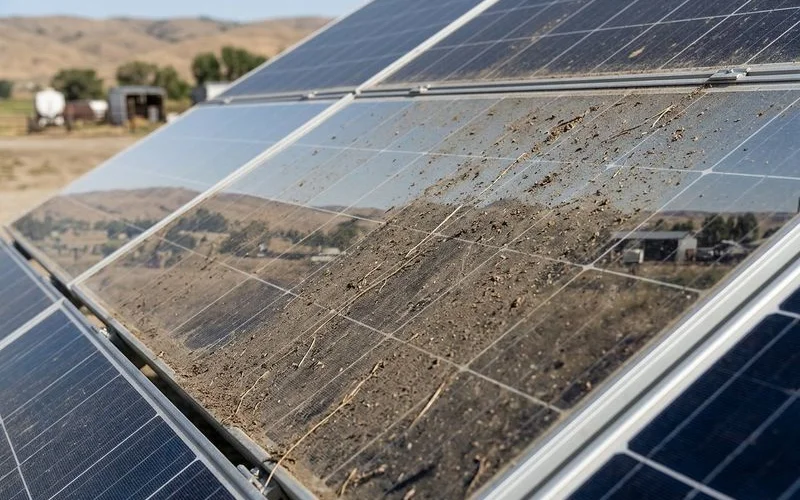
Agricultural dust is a highly complex mixture of fine soil particles, organic plant matter, pollen, fertilizer residue, and moisture from irrigation runoff. The National Renewable Energy Laboratory reports that while urban panels might lose just 5 percent of efficiency to dirt, agricultural panels can experience devastating losses exceeding 30 percent. This dramatic difference comes down to how the material physically bonds to the array.
When this cocktail of organic and mineral material lands on a solar panel surface, it glues itself tightly to the glass.
Morning dew wets the accumulated dirt layer. The hot afternoon sun then bakes it into a hard, protective crust.
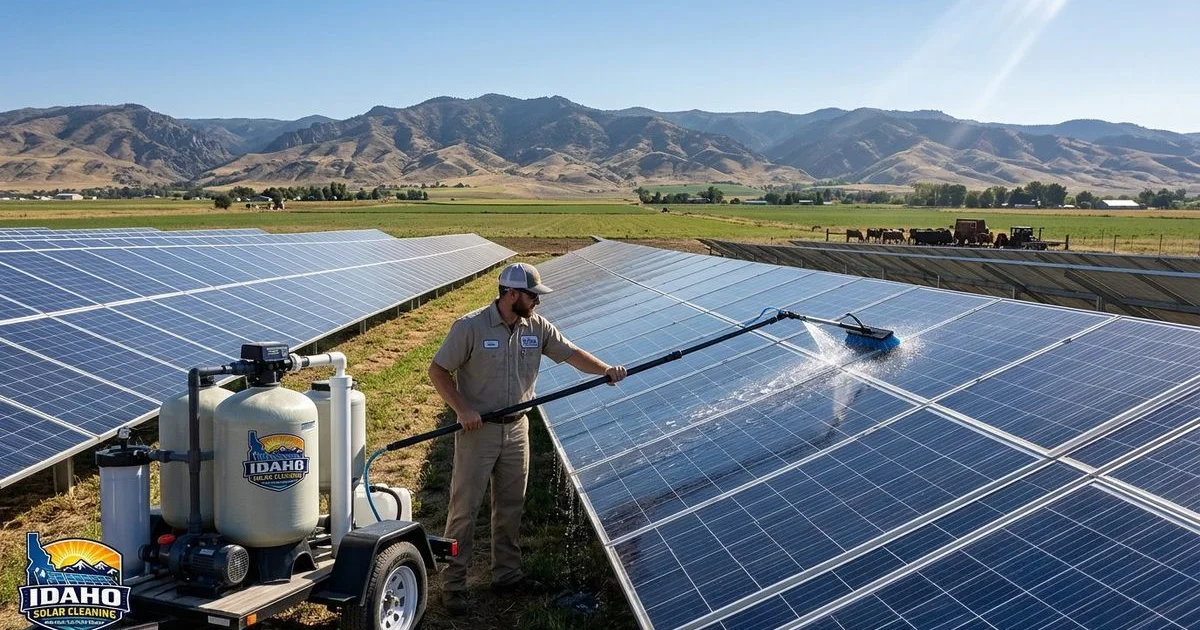
Within just a few weeks, this bonded organic film becomes highly resistant to rain and moderate wind. We use specialized equipment with deionized water and soft brushes to remove this crust safely. Professional agitation is required to clean the surface without scratching the delicate anti-reflective coating applied at the factory.
Standard rinse-only methods are completely ineffective against this type of agricultural soiling.
Here is why a standard garden hose approach fails on farm arrays:
- Organic Adhesives: Plant matter and pollen act like natural binding agents.
- Mineral Hardening: Sun-baked soil turns into a tough, cement-like layer.
- Thermal Shock Risk: Spraying cold well water on hot glass can cause permanent micro-fractures.
- Mineral Staining: Hard well water leaves thick calcium deposits that block vital sunlight.
Farm operators who attempt to clean their own arrays often find the panels look just as dirty the very next day.
The Idaho Agricultural Calendar and Solar Panel Soiling
Agricultural dust generation directly follows the demanding farming calendar. This creates a frustrating irony for solar owners, as the heaviest soiling periods overlap exactly with the longest, most productive days of summer.
Spring Plowing and Planting
Spring fieldwork from April through May stirs up massive quantities of loose topsoil. Wind carries these fine particles across entire valleys, coating any solar array within a mile of an active tractor.
The characteristic spring winds of the Treasure Valley make this local problem significantly worse.
We frequently find that brand-new installations accumulate visible, power-robbing contamination within just a few days of local planting operations.
Summer Irrigation and Haying
Summer operations from June through August create a highly problematic contamination profile. Irrigation sprinklers generate localized humidity that quickly combines with airborne field dust.
This trapped moisture forms a particularly sticky slurry right on the panel surfaces.
Alfalfa cutting and baling operations launch enormous clouds of organic particulate into the warm summer air. Panels located downwind of these operations will become heavily coated in a single afternoon.
The Fall Harvest Challenge
Harvest season from September through October represents the absolute worst period for solar panel soiling in Idaho. Combine harvesters pulling sugar beets, heavy grain trucks, and aggressive post-harvest tillage tools generate dense, sustained dust plumes.
These thick clouds reduce local visibility and blanket solar arrays in heavy layers of crop residue.
Many farm operators desperately need their solar panels performing at peak capacity during this exact window to power energy-intensive grain dryers and storage facilities.
Canyon County: Ground Zero for Agricultural Solar Challenges
Canyon County requires special attention because it sits right at the intersection of intensive agricultural activity and rapid solar adoption. This flat, fertile farmland supports massive dairy operations, row crops, expansive onion fields, and crowded feedlots.
Every single one of these commercial operations generates substantial airborne contamination.
Solar installations in active farming communities like Nampa, Caldwell, Middleton, Greenleaf, and Parma face exceptionally aggressive soiling conditions.
We routinely service panels in these specific areas that accumulate more dirt in six weeks than a suburban Boise home sees in an entire year.
Monthly cleaning during the active growing season is a strict financial necessity for Canyon County farm operators. This scheduled maintenance directly protects their energy production and guarantees a long-term return on investment.
“Dairy operations present a unique chemical hazard for solar glass. Ammonia-rich airborne particulate from feedlots creates a highly corrosive film that can permanently etch solar panel coatings if left untreated for long periods.”
Farm operators located near large dairy facilities must schedule bi-weekly panel inspections during peak summer months. Regular visual checks help prevent irreversible surface damage from this caustic chemical buildup.
Pesticide and Herbicide Drift: A Hidden Threat
Chemical drift from active crop spraying introduces a unique and invisible contamination hazard for agricultural arrays. Ground sprayers and aerial applicators distribute chemical herbicides, pesticides, and fungicides as fine mists.
These tiny droplets frequently drift significant distances on the wind before landing directly on your solar panels.
Several common agricultural sprays cause immediate efficiency issues upon contact:
- Pre-emergent Herbicides: Leave heavy, sticky residues that attract secondary dust.
- Commercial Fungicides: Contain aggressive binding agents designed to stick to leaves.
- Liquid Fertilizers: Deposit corrosive nitrogen and phosphorus salts on the glass.
These commercial agricultural chemicals contain specialized surfactants designed to make the liquid stick stubbornly to plant leaves.
Unfortunately, these same sticky properties cause the chemicals to bond aggressively to smooth solar panel glass. This filmy residue is entirely impossible to remove with simple water and light water pressure.
Even worse, prolonged exposure to these harsh agricultural chemicals can severely degrade the factory anti-reflective coatings on modern panels. Our specific cleaning protocols effectively neutralize and lift these chemical deposits before they have time to cause lasting optical damage.
Cleaning Strategies for Farm Solar Arrays
Most agricultural solar installations utilize ground-mounted racking systems rather than standard rooftop setups. This practical layout creates distinct maintenance advantages, as ground-mounted panels are significantly easier and safer to reach.
Faster access translates directly into faster cleaning times and much lower per-service costs for the farm owner.
However, their low profile puts them right in the crosshairs of ground-level dust generation, splashing irrigation water, and curious local wildlife.
For standard ground-mounted farm arrays, we strongly recommend a strict schedule of monthly cleanings from April through October. Quarterly maintenance cleanings generally provide enough protection during the slower, wetter winter months.
| Service Timing | Primary Contaminant Target | Goal for the Farm Array |
|---|---|---|
| Post-Planting (May) | Loose topsoil, seed dust, pollen | Clear the heavy spring dirt crust |
| Mid-Summer (July) | Irrigation residue, alfalfa dust | Maximize peak summer sun absorption |
| Pre-Harvest (August) | Dried soil, chemical spray drift | Prepare for high fall energy demands |
| Post-Harvest (October) | Heavy crop residue, tractor exhaust soot | Clean the glass before winter snowpack |
Scheduling these cleanings around your active farm operations is completely essential to minimize daily workflow disruptions.
This structured minimum schedule should always be adjusted if you experience particularly dusty periods or aggressive nearby field burns.
Water Quality Matters on Rural Properties
Water chemistry dictates the actual success or complete failure of any commercial solar cleaning effort. Many rural Idaho properties rely on deep agricultural wells that pull incredibly hard, mineral-heavy water.
The United States Geological Survey consistently notes that groundwater in the Snake River Plain contains exceptionally high concentrations of dissolved calcium and magnesium.
“Water with a hardness level above 120 parts per million will immediately calcify on hot solar glass. Many agricultural wells in Canyon and Owyhee counties test well above 200 parts per million, making untreated well water incredibly destructive to solar efficiency.”
Using this untreated well water to wash hot solar panels is a massive, costly mistake. The heavy mineral content immediately bakes onto the hot glass surface and forms permanent white scales.
These stubborn hard water spots physically block sunlight and reduce electrical efficiency far worse than the original field dirt.
Our self-contained mobile units utilize advanced multi-stage filtration to produce 100 percent pure deionized water. This completely eliminates the need to connect to your hard well water, as our technicians bring purified supplies directly to your remote property.
The immediate result is a perfectly clear, streak-free finish that allows maximum solar radiation to reach the active silicon cells.
Protecting Your Agricultural Solar Investment
Farm solar installations in Idaho represent a brilliant long-term strategy for stabilizing your volatile overhead costs.
That major upfront investment only delivers its promised financial returns when the panels operate efficiently.
You must commit to maintaining your expensive equipment with specific strategies designed for harsh agricultural environments.
Professional commercial solar panel cleaning for Idaho farms and agricultural operations easily pays for itself by immediately recovering your lost energy production.
Contact our team today to schedule a complete site assessment and power production analysis.
We will calculate your current efficiency losses and build a customized maintenance plan that fits your exact farming schedule.