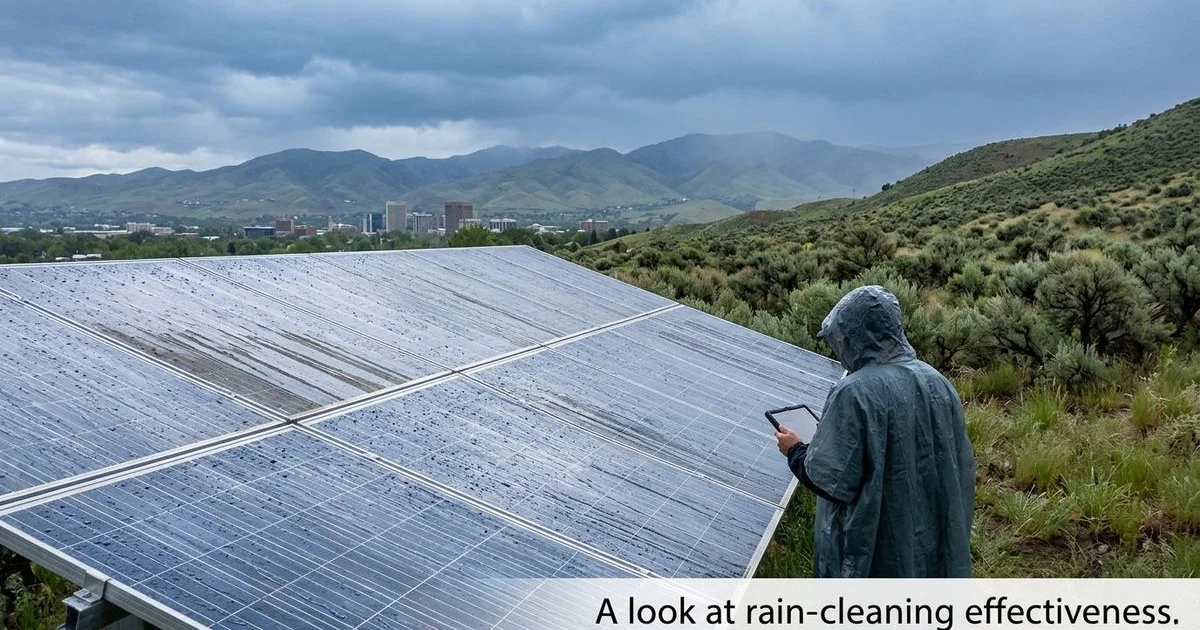
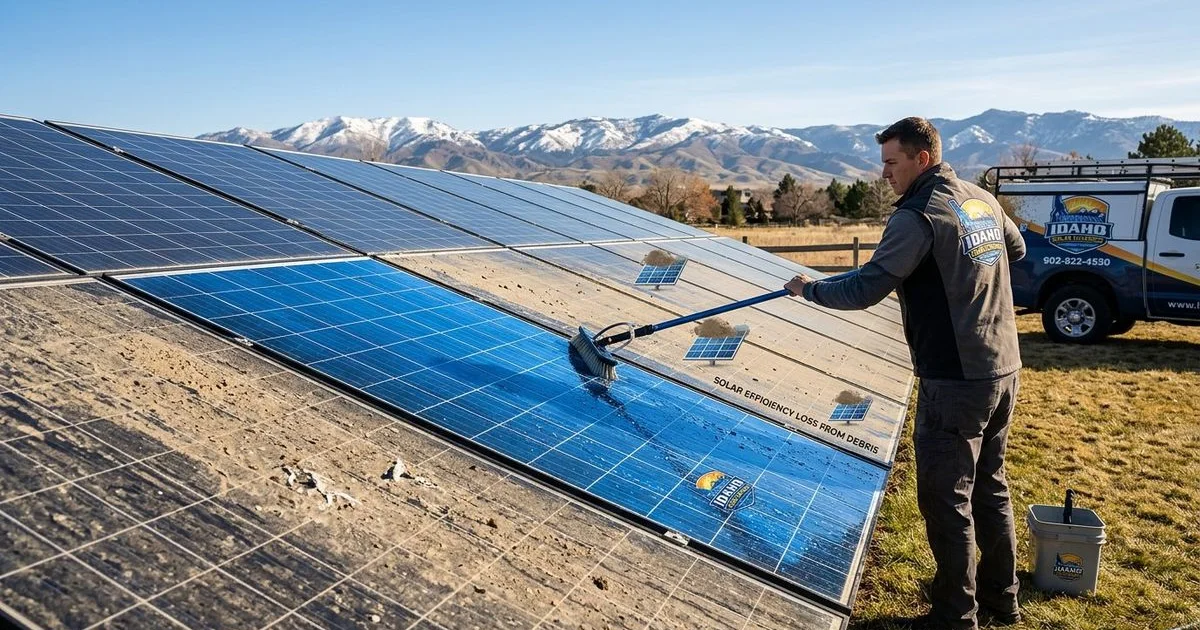
Many property owners assume the next rainstorm will naturally wash their arrays. The reality of understanding solar panel efficiency loss from dirt & debris is much more complex. A recent 2025 review of regional energy production shows that neglected arrays lose significant amounts of power.
Our professional solar panel cleaning service team has documented hundreds of systems across Idaho, tracking exactly how everyday environmental elements degrade performance. The data reveals a surprising truth about your system’s output.
This guide breaks down the hard numbers behind soiling. You will learn the exact steps required to reclaim that lost energy.
Understanding Solar Panel Efficiency Loss from Dirt & Debris: The Science of Soiling
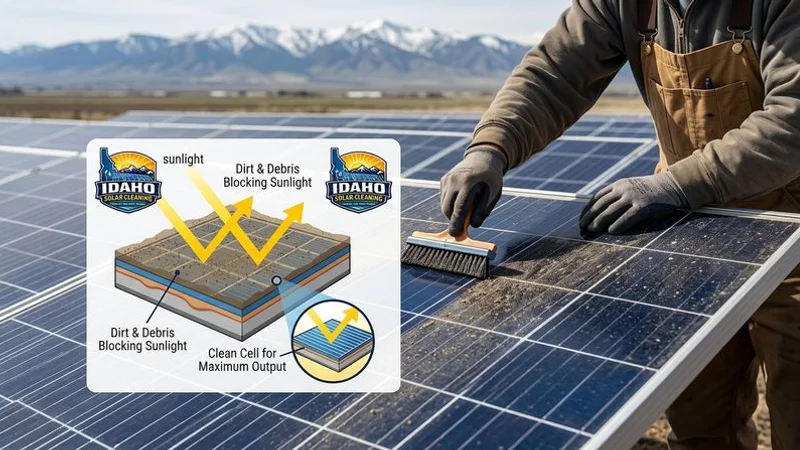
Solar panels convert sunlight into electricity through a straightforward process. Photons from the sun pass through the protective glass cover, strike the photovoltaic cells beneath, and knock electrons free to generate an electrical current. Every link in that chain depends on a single critical variable. That variable is how much light actually reaches the cells.
We refer to this performance reduction in the industry as soiling loss. This phenomenon is one of the most preventable causes of diminished solar panel output across the United States. National Renewable Energy Laboratory data from early 2026 indicates that arid regions can experience localized soiling losses exceeding 30 percent annually.
Our specific climate and environmental conditions in Idaho amplify these losses beyond what homeowners in wetter states experience. Anything that reduces light transmission through the glass directly reduces the amount of electricity your system can produce.
“Even a seemingly transparent layer of fine summer dust can force your system to underperform by nearly a tenth of its capacity, day after day.”
How the Glass Layer Affects Panel Output
The Engineered Transparency of Solar Panel Glass
The top surface of every solar panel features a sheet of tempered, low-iron glass, typically 3 to 4 millimeters thick. Manufacturers specifically engineer this layer to maximize transparency while protecting the fragile cells underneath from weather, mechanical impact, and ultraviolet degradation. Modern panels from tier-one brands like Qcells or SunPower can transmit up to 95 percent of incoming sunlight under ideal clean conditions.
Our technicians frequently note the specialized anti-reflective coating on these high-end panels. This microscopic layer minimizes the amount of sunlight that bounces off the surface instead of passing through. This coating creates the characteristic dark blue or black appearance of solar panels and adds another 2 to 3 percent improvement in light absorption.
Three Ways Soiling Reduces Light Transmission
Accumulating material on the glass surface interferes with light transmission through three distinct mechanisms.
- Absorption: Dark particles like soot, carbon ash, and certain types of mineral dust absorb light energy and convert it to heat, preventing those photons from ever reaching the cells.
- Reflection: Lighter-colored particles and crystalline mineral deposits scatter and reflect incoming sunlight away from the panel surface before it can enter the glass.
- Diffusion: Biological films, pollen layers, and fine mineral coatings create a translucent barrier that diffuses light, reducing the concentrated intensity of photons even when the surface appears only slightly hazy.
We always warn property owners that the relationship between soiling and output loss is not perfectly linear. The first thin layer of contamination disrupts the carefully engineered optical properties of the glass, causing a proportionally larger impact than subsequent layers. Even panels that appear only slightly hazy might be losing significant energy.
Types of Soiling and Their Measured Impact on Efficiency
Particulate Dust: 3 to 8 Percent Loss
Fine airborne dust remains the most common soiling agent worldwide. Idaho’s dry climate makes this a persistent challenge for local property owners. Dust originating from unpaved roads, construction activity, agricultural operations, and natural wind erosion accumulates steadily throughout the year.
Our field tests in the Treasure Valley consistently show summer dust accumulation rates far above the US national average. Dust soiling typically causes a 3 to 8 percent efficiency loss, depending on local environmental conditions. The loss increases linearly over time until heavy rainfall or professional cleaning resets the surface. Light drizzle actually makes the problem worse by turning dry dust into a baked-on mud film.
Pollen: 5 to 15 Percent Loss
Pollen ranks among the most significant soiling agents in the region, particularly during the spring months. Cottonwood trees, junipers, and various grasses release enormous quantities of sticky, lipid-based pollen into the air. Cottonwood pollen proves especially problematic because its large, fibrous structure adheres aggressively to panel surfaces.
We routinely measure 10 to 15 percent production losses during peak pollen season in April and May on panels located near heavy tree stands. Pollen creates a distinctive yellow-green film that blocks sunlight with surprising effectiveness. Natural oils and sugars in the pollen cause it to bond tenaciously to glass, rendering even moderate rainfall useless for natural cleaning.
Bird Droppings: 10 to 25 Percent Loss Per Affected Cell
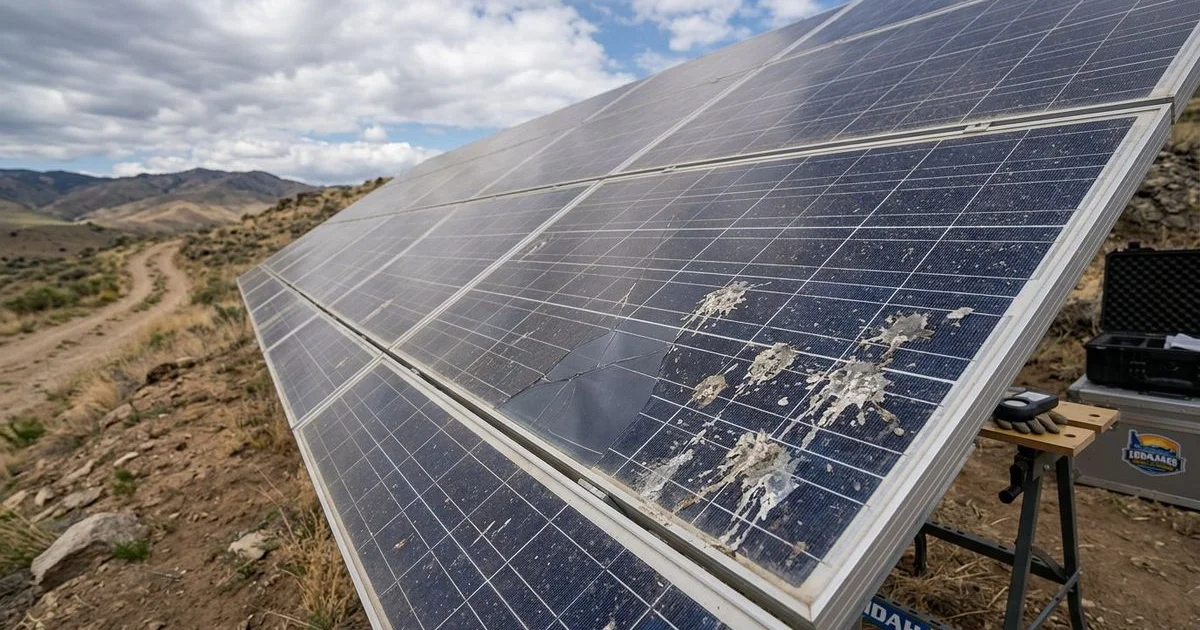
Bird droppings require immediate attention because their impact is wildly disproportionate to their physical size. A single dropping covering a small portion of one cell can trigger the panel’s bypass diode. This safety mechanism shuts down an entire string of cells to prevent overheating, effectively cutting that panel’s output by a third.
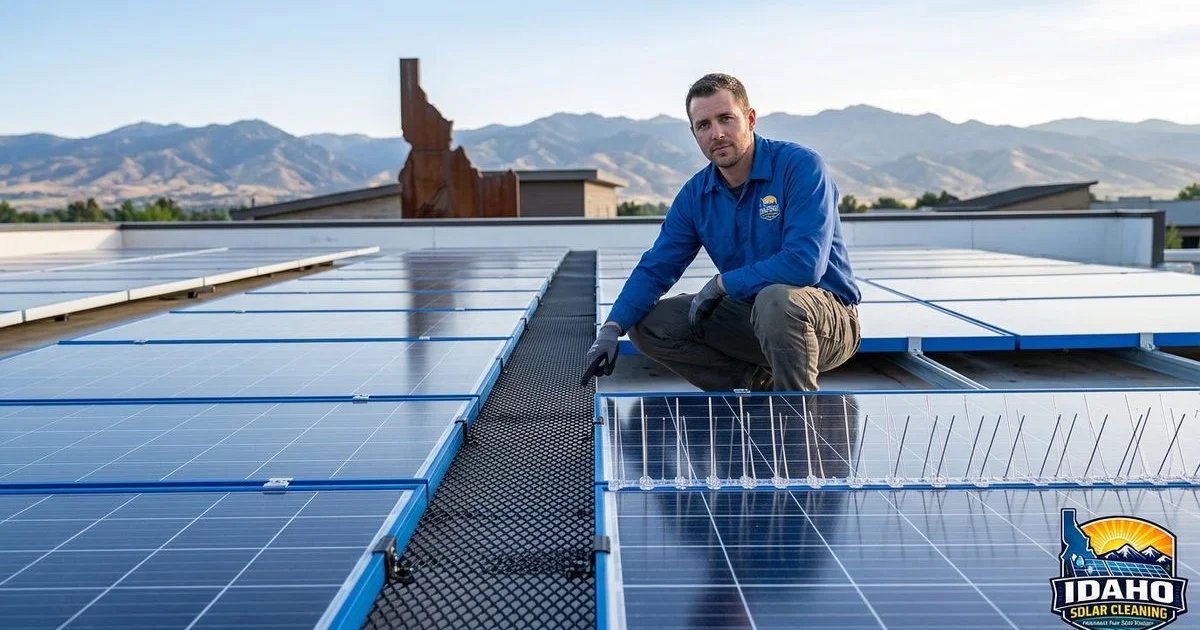
Our crews frequently encounter permanent damage caused by the highly acidic nature of these droppings. High concentrations of uric acid, which typically has a pH level between 3.0 and 4.5, will corrode both the glass surface and the delicate anti-reflective coating. Pigeon and starling populations in the Treasure Valley create a massive headache for installations lacking proper critter guard protection. Left untreated, droppings etch permanent marks into the glass and create sustained hot spots.
Wildfire Smoke and Ash: 10 to 30 Percent Loss
The regional wildfire season introduces a dramatic, multi-layered impact on solar efficiency from June through October. Suspended particles in the atmosphere block sunlight before it ever reaches your roof. Fine ash and soot then settle on the panel surfaces, continuing to block light long after the visible smoke clears.
We track post-wildfire soiling losses carefully, and production drops of 15 to 30 percent are incredibly common. Atmospheric smoke is temporary, but surface deposits remain indefinitely until physically removed. This sticky, light-absorbing residue consists of fine carbon particles, mineral ash, and volatile organic compounds that water alone cannot break down.
Biological Growth: 15 to 25 Percent Loss
Lichen, moss, and algae colonize solar panel surfaces in areas receiving partial shade or collecting excess moisture. Arid climates see less biological growth generally, but it still appears near irrigation systems or on roof sections with poor drainage. Crustose lichens actively bond to the surface and penetrate the micro-texture of the glass coating.
Our maintenance teams consider biological growth the most persistent form of soiling. You should never use a high-pressure washer to remove these colonies, as intense water pressure can instantly void your manufacturer warranty. Progressive layers require specialized cleaning solutions and gentle mechanical agitation to remove safely.
Idaho-Specific Factors That Amplify Soiling Losses
| Environmental Factor | Primary Soiling Source | Average Annual Impact |
|---|---|---|
| Arid Climate | Fine mineral dust | High (No natural washing) |
| Elevation | UV baking effect on organics | Moderate to High |
| Agriculture/Construction | Heavy particulates, soil, sawdust | High (Localized) |
| Thermal Cycling | Glass expansion trapping dirt | Moderate (Cumulative) |
Minimal Summer Rainfall Means No Natural Cleaning
The Treasure Valley receives only about 12 inches of precipitation annually, heavily concentrated in winter and spring. Industry standards state that panels require at least 0.8 inches of steady, heavy rain to achieve any meaningful natural washing effect. Weeks or months of rainless summer days allow contaminants to accumulate during the peak solar production season.
High Elevation Increases UV Intensity
Elevations ranging from 2,700 feet to over 5,000 feet expose panels to intense ultraviolet radiation. This heightened UV exposure accelerates chemical changes in certain types of soiling deposits. The sun effectively bakes organic matter onto the glass surface, making it progressively harder to remove the longer it sits.
Temperature Extremes Embed Soiling Into Glass
Dramatic daily temperature swings create a harsh thermal cycling process. The glass expands slightly as panels heat during the day, pressing surface contaminants into microscopic textures. Dew formation overnight causes mineral crystallization, which further anchors the deposits.
Agricultural and Construction Activity
Rapid development in areas like Meridian and Nampa generates substantial airborne particulates. Agricultural operations produce fine soil particles and pesticide residue, while active construction kicks up concrete dust and wood sawdust.
Tracking Your Own Soiling Losses
Monitoring your production data over time provides the clearest picture of your system’s health. Modern inverter platforms like Enphase Enlighten or the SolarEdge monitoring portal offer granular insights into your daily output.
Our team recommends reviewing several key metrics to establish a reliable performance baseline.
- Daily production per kilowatt of installed capacity normalizes your data for system size and enables meaningful comparison across time periods.
- Month-over-month production trends adjusted for seasonal changes in solar irradiance and day length.
- Pre-cleaning versus post-cleaning output reveals exactly how much energy soiling was costing you.
- System alerts indicating underperforming microinverters triggered by hard shading from bird droppings.
Restoring Your Panels to Peak Performance
The good news is that soiling loss is almost entirely reversible through proper professional maintenance. Spraying panels with a standard garden hose often leaves hard water scale and calcium deposits, which block even more light. A proper cleaning requires purified Reverse Osmosis and Deionized (RO/DI) water to leave the glass perfectly spotless.
We recommend a minimum of two professional cleanings per year for Idaho properties. A comprehensive solar panel inspection establishes a performance baseline and identifies any permanent coating damage. This process reveals exactly how much energy understanding solar panel efficiency loss from dirt & debris is costing your specific property.
Monitor your system’s dashboard this week to check for unexpected production dips. If you suspect your panels are underperforming, schedule a professional assessment today. Our technicians will evaluate your system, provide a detailed production analysis, and outline a customized maintenance schedule. Learn more about our residential solar panel cleaning services and discover how we restore systems to maximum output.