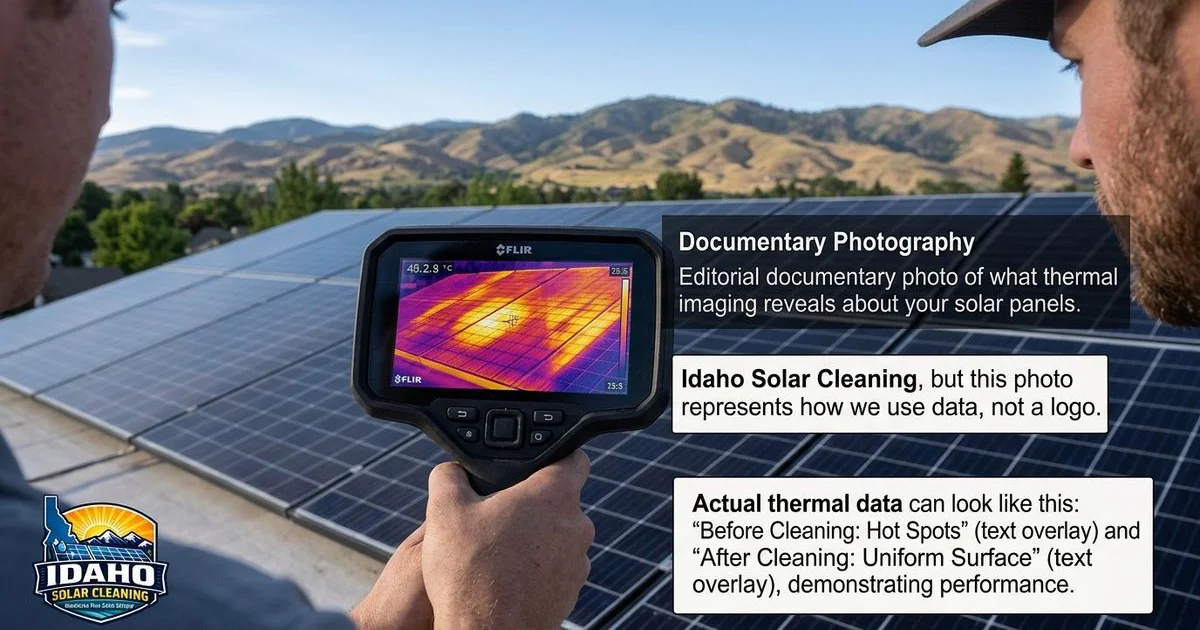
We often see property owners assume their array is flawless simply because it looks fine from the driveway.
The glass appears intact, the frames are straight, and nothing seems out of place. But beneath that normal exterior, hidden problems silently drain your energy production.
This is exactly what thermal imaging reveals about your solar panels.
Our diagnostic approach, as part of our professional solar panel cleaning services, connects these invisible temperature differences directly to your monthly utility bills. Let’s look at the data, what it actually tells us, and explore a few practical ways to respond.
Seeing What the Naked Eye Cannot
Your solar panels might look perfectly fine from the ground, but infrared technology reveals a completely different story.
Thermal imaging, also called infrared thermography, uses specialized radiometric cameras that detect heat radiation instead of visible light. Every object emits infrared energy based on its temperature.
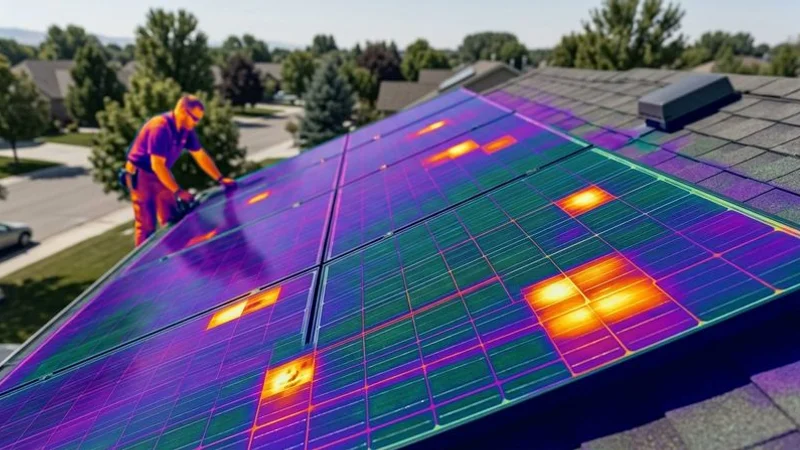
Our equipment translates those temperature differences into a color-coded visual map. Hotter areas appear in warmer colors like red and yellow, while cooler areas show in blues and purples.
Key advantages of our thermal diagnostic equipment include:
- High Sensitivity: We use cameras with a thermal sensitivity below 0.05 degrees Celsius (50 mK).
- Instant Anomaly Detection: Damaged areas generate excess heat that immediately stands out on a scan.
- Non-Invasive Testing: The entire array can be evaluated safely while the system remains fully operational.
A healthy solar panel operating under load displays a relatively uniform temperature across its surface.
When aimed at solar arrays, this technology identifies hidden faults with incredible precision. This makes infrared scanning one of the most powerful diagnostic tools available for system maintenance today.
What Thermal Imaging Reveals About Your Solar Panels
Hot Spots
Hot spots are the most frequently identified issue during thermal inspections and among the most damaging problems a module can develop. A hot spot occurs when one or more cells generate significantly more heat than the surrounding area.
This happens when a cell is partially shaded, physically damaged, or internally defective. The cell then acts as an electrical resistor rather than a power generator.
Our recent field assessments show these concentrated areas can easily reach 10 to 40 degrees Celsius warmer than the surrounding surface. Decades of research from the National Renewable Energy Laboratory (NREL) show that normal, high-quality panels typically degrade at a rate of 0.5 percent to 1 percent per year.
But severe hot spots accelerate this degradation rapidly. Temperatures can climb high enough to cause permanent cell damage, delamination of the backing material, and even melting of the Ethylene Vinyl Acetate (EVA) encapsulant layer.
Common causes of hot spots on Idaho solar panels include:
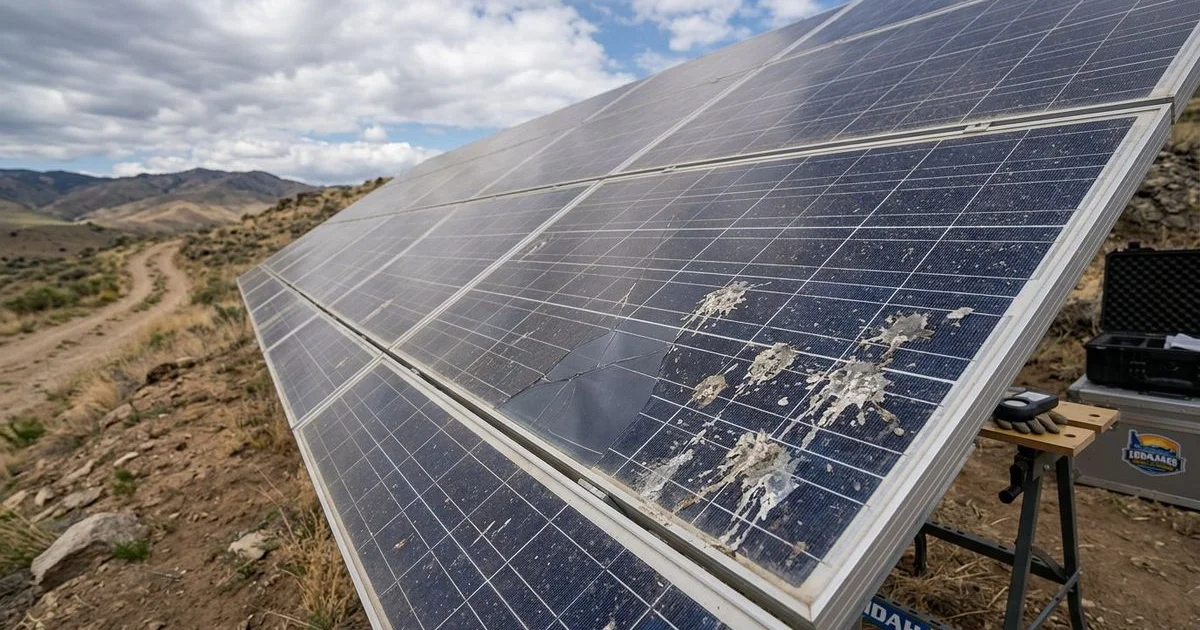
- Bird droppings covering individual cells and forcing them to operate as resistors.
- Localized soiling from tree sap, concentrated pollen deposits, or construction dust.
- Cell micro-cracks caused by hail impacts, thermal cycling, or installation stress.
- Manufacturing defects in individual cells that only manifest under real operating conditions.
- New shading from tree growth, antenna installations, or neighboring construction.
Micro-Cracks and Internal Cell Damage
Micro-cracks are microscopic fractures in the silicon wafers that form each solar cell, often measuring just micrometers in width. They are completely invisible to the naked eye and frequently pass standard electrical testing during their early stages.
Cracked cells generate uneven heat patterns as electrical current flow is disrupted through the damaged material.
Our thermal cameras detect these disruptions instantly. Idaho’s climate is particularly harsh on delicate silicon wafers.
Primary drivers of micro-crack formation in our region include:
- Extreme Temperature Swings: The shift between 100-degree summer days and sub-zero winter nights creates immense thermal stress.
- Hail Impacts: Even small hail that leaves the glass intact can shatter the internal cells.
- Physical Stress: Wind loading and heavy snow accumulation can bend the frames and crack the wafers.
Each heating and cooling cycle can propagate existing cracks and initiate new ones. After any significant weather event, a thermal scan is the only reliable method to verify your system survived without hidden damage.
String and Bypass Diode Failures
Solar panels contain multiple strings of cells connected in series, protected by bypass diodes that activate when individual strings underperform. When a bypass diode engages, the affected string goes offline, and the energy from that portion of the panel is lost entirely.
Thermal imaging clearly reveals when a bypass diode activates because the affected string of cells drops to a noticeably different temperature. A thermal pattern showing one-third or one-half of a panel at a distinct temperature is a telltale sign of a string-level issue.
Our technicians also use these scans to detect failing bypass diodes themselves. A diode stuck in the conducting position appears as a concentrated hot spot at the junction box.
Safety Warning: A completely failed bypass diode allows dangerous reverse-current conditions. The resulting localized heat can easily exceed 90 degrees Celsius, creating a severe fire hazard on your roof.
Electrical Connection and Wiring Issues
Loose, corroded, or damaged electrical connections generate excess heat that thermal cameras detect easily. These problems are incredibly dangerous because they develop slowly over years.
According to the National Fire Protection Association (NFPA), electrical arc faults account for 42 percent of all solar system fires.
Our thermal scanning isolates these high-resistance points before they ignite. The inspection process specifically targets the following failure points:
- MC4 Connectors: High resistance caused by improper crimping or cross-mating incompatible connector brands (like mixing Stäubli with generic parts).
- Junction Boxes: Corroded terminals that degrade electrical contact.
- Cable Runs: Damaged wiring resulting from rodent activity or intense UV exposure.
Catching these connection failures early prevents arcing and catastrophic system damage.
Delamination and Moisture Intrusion
Delamination occurs when the internal layers of a solar panel begin to separate, typically at the boundary between the glass, encapsulant, and cell layers. This separation creates air pockets that trap moisture, which accelerates corrosion in a destructive, irreversible cycle.
We spot delamination on thermal images as irregularly shaped warm zones. The trapped air or moisture acts as insulation, preventing normal heat dissipation from the affected cells.
Catching this early is essential to protect your remaining array. Once moisture degrades the internal components beyond a certain point, the panel is fully compromised and requires a complete replacement.
How We Perform Thermal Inspections in Idaho
Our thermal inspection process delivers the most accurate and actionable diagnostic information possible for local property owners.
Conditions Required for Accurate Scanning
Thermal imaging must happen under specific conditions to produce reliable results.
We strictly follow the IEC 62446-3:2022 global standard for thermographic inspections. This protocol ensures the data we collect is accurate, repeatable, and valid for warranty claims.
Idaho’s climate provides excellent conditions for these inspections from May through September.
Requirements for an IEC-compliant scan:
- Full sun operation: Irradiance must be at least 600 watts per square meter (W/m²).
- Low wind speeds: Winds must remain below 10 kilometers per hour to prevent uneven cooling across the glass.
- Clear skies: Cloud-free conditions for at least 30 minutes before scanning ensure temperatures have stabilized.
- Mid-day timing: Scanning between 10 AM and 2 PM provides the optimal combination of solar energy and operating temperature.
Our Inspection Process Step by Step
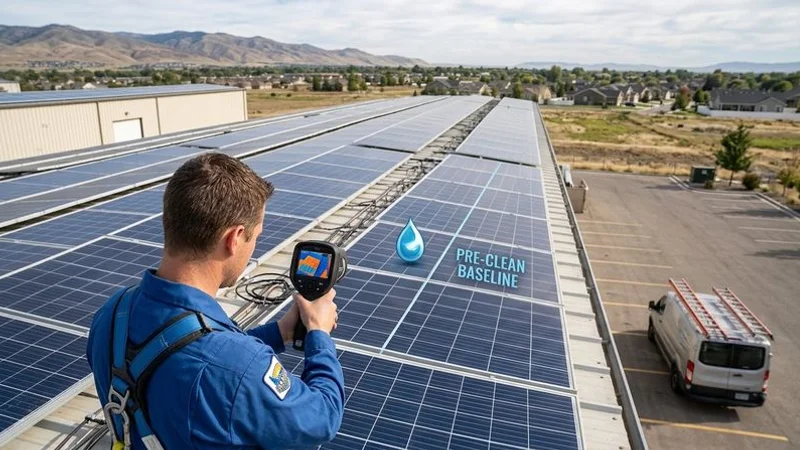
We use specialized radiometric equipment, like the DJI Mavic 3T drone or FLIR handheld cameras, to capture precise data. The process follows a strict methodology to ensure nothing gets missed.
| Inspection Phase | Actions Performed | Key Deliverable |
|---|---|---|
| 1. Data Review | Analyze inverter data and historical production metrics. | Baseline performance context. |
| 2. Visual Check | Inspect mounting hardware, wiring, and roof penetrations. | Identification of obvious physical damage. |
| 3. Thermal Scan | Capture high-resolution infrared maps of every cell cluster. | Raw temperature data and anomaly detection. |
| 4. Expert Analysis | Classify faults by severity based on temperature differentials. | Prioritized list of system defects. |
Real Cases From Idaho Solar Systems
We encounter hidden issues across the state every single week. These real-world examples highlight exactly why visual checks are never enough.
Hidden Hail Damage in Eagle
A homeowner in Eagle had a 24-panel system that appeared completely undamaged after a summer hailstorm. Their production monitoring showed a modest 5 percent drop that they attributed to normal seasonal variation.
Our thermal scan revealed micro-crack damage across six panels that was entirely invisible to the naked eye.
Armed with our thermal documentation, the homeowner filed a successful insurance claim. At an average 2026 replacement cost of $300 to $400 per panel plus labor, this documentation saved them over $3,000 in out-of-pocket expenses.
Bird Dropping Hot Spots in Meridian
A Meridian homeowner experienced a persistent 12 percent production decline but could not identify any obvious problems from ground level.
Our thermal inspection revealed severe hot spots on four panels caused by concentrated bird droppings. The steep panel tilt angle hid this mess from driveway view.
After professional cleaning restored production to normal levels, the homeowner opted for a critter guard installation. This simple upgrade prevented future nesting and secured their energy output.
Dangerous Connection Failure in Boise
A Boise homeowner noticed one string of their system was consistently producing less than the others.
Our thermal inspection of the junction boxes revealed a corroded MC4 connector generating dangerously elevated temperatures. The Stäubli connector had been cross-mated with a generic brand, creating a high-resistance fault.
The repair cost was minimal, but leaving it undetected could have easily escalated to an electrical fire. Early detection through thermal imaging potentially saved the entire property.
Recommended Thermal Inspection Schedule for Idaho
For most property owners, we recommend proactive inspections rather than waiting for a noticeable drop in power. The core benefit of infrared scanning is early detection.
Triggers for scheduling an inspection:
- Annually as part of a comprehensive maintenance program.
- After any hailstorm producing hail larger than pea-sized.
- After any unexplained production drop exceeding 5 percent that does not correlate with weather patterns.
- On systems older than 10 years where age-related cell degradation becomes increasingly likely.
- After any electrical work performed on your solar system or main electrical panel.
Problems that cost a few hundred dollars to address today can balloon into massive repair bills later. Freeze-thaw cycles, UV exposure, and thermal stress will rapidly worsen any existing vulnerability.
Thermal Imaging as Part of Comprehensive Diagnostics
Thermal imaging is one critical component of a thorough solar panel assessment, as each diagnostic method catches different categories of issues. It performs best when integrated with a complete diagnostic suite, including:
- Visual Inspections: For hardware and mounting integrity.
- Electrical Testing: For string-level voltage and current verification.
- Data Analysis: For historical production benchmarking.
Our solar panel inspection service combines all of these approaches into a single visit. This comprehensive assessment delivers a full understanding of your system’s condition along with a clear, prioritized action plan.
Whether your system is newly installed or a decade old, a professional check-up is the smartest move. It is the most effective way to protect your solar investment in Idaho.
Schedule your thermal imaging inspection today and discover what thermal imaging reveals about your solar panels. Contact our team to book your service.