From what our crew has seen over years of property maintenance, most people treat their solar arrays like an extension of their roof. You assume a quick rinse with the garden hose is enough to keep things running smoothly. This assumption makes sense until you look at the performance data.
We regularly see systems lose a massive amount of efficiency simply because of the water used to wash them. The real culprit is dissolved minerals. Elements like calcium, magnesium, and silica are invisible in liquid form, but they leave behind a stubborn residue the moment water evaporates on your panel glass.
That is exactly why purified water matters for solar panel cleaning.
Our goal today is to break down the science behind water purification and explain what hard water actually does to your equipment. Let us explore the practical steps you can take to protect your system’s energy output.
The Hidden Danger of Cleaning Solar Panels With Tap Water
Most homeowners assume that water is just water. You grab the garden hose, spray down your solar panels, and call it a day. Unfortunately, in Idaho, that approach can actually make your panels perform worse than if you had never cleaned them at all.
We rely on verified data to guide our maintenance protocols. A 2025 joint study from Duke University and the Indian Institute of Technology found that airborne pollutants and water spots can drop panel efficiency by up to 25% in just a few weeks. The financial impact is significant:
- A typical 5-kilowatt to 10-kilowatt residential system loses 15% to 20% efficiency from mineral scaling.
- Annual energy losses can easily reach $300 to $600.
- The break-even timeline for your solar investment gets extended by years.
Professional solar panel cleaning companies rely on purified water processed through reverse osmosis and deionization systems, commonly referred to as RO/DI water. This is not a luxury upsell or a marketing trick. It is a science-backed requirement that directly impacts how much electricity your panels generate after a cleaning and how long they stay clean.
Our recommendation is to monitor your solar inverter app closely. A sudden, unexplained 5% to 10% drop in energy output is your first clear warning sign that residue is blocking sunlight. For Idaho homeowners dealing with some of the hardest water in the country, understanding this distinction is critical for maximizing your return on investment.
How RO/DI Purification Works
The Two-Stage Process
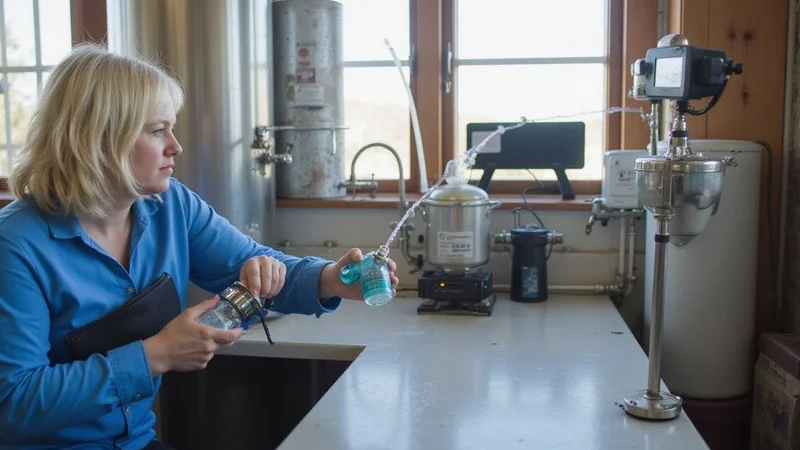
RO/DI water purification involves multiple complementary stages that work together to remove virtually all dissolved solids from water. We use commercial-grade equipment like the Tucker 4060 mobile RO/DI cart to achieve perfect results. These heavy-duty systems use 30-inch membranes to process water rapidly on-site.
The purification process involves two primary steps:
- Reverse Osmosis: Water is pushed through a semi-permeable membrane under high pressure. This membrane allows water molecules to pass through while blocking dissolved minerals, salts, and contaminants. This stage alone removes approximately 95 to 99 percent of total dissolved solids.
- Deionization: The already-filtered water passes through a specialized resin bed that captures any remaining charged particles, or ions. This final polishing step brings the water to near-zero total dissolved solids (TDS), typically measuring between 0 and 5 parts per million.
To put that in perspective, Idaho tap water commonly measures between 150 and 400 parts per million of total dissolved solids depending on your municipality and water source. That is an enormous amount of mineral content that gets deposited on every surface the water touches as it dries.
Why Pure Water Cleans Better Than Tap Water
Purified water has an inherent cleaning advantage that surprises most people. Because RO/DI water contains virtually no dissolved substances, it actively seeks to absorb contaminants from any surface it contacts. Scientists sometimes describe it as “hungry water” because it is eager to dissolve and carry away dirt, dust, pollen, and residue.
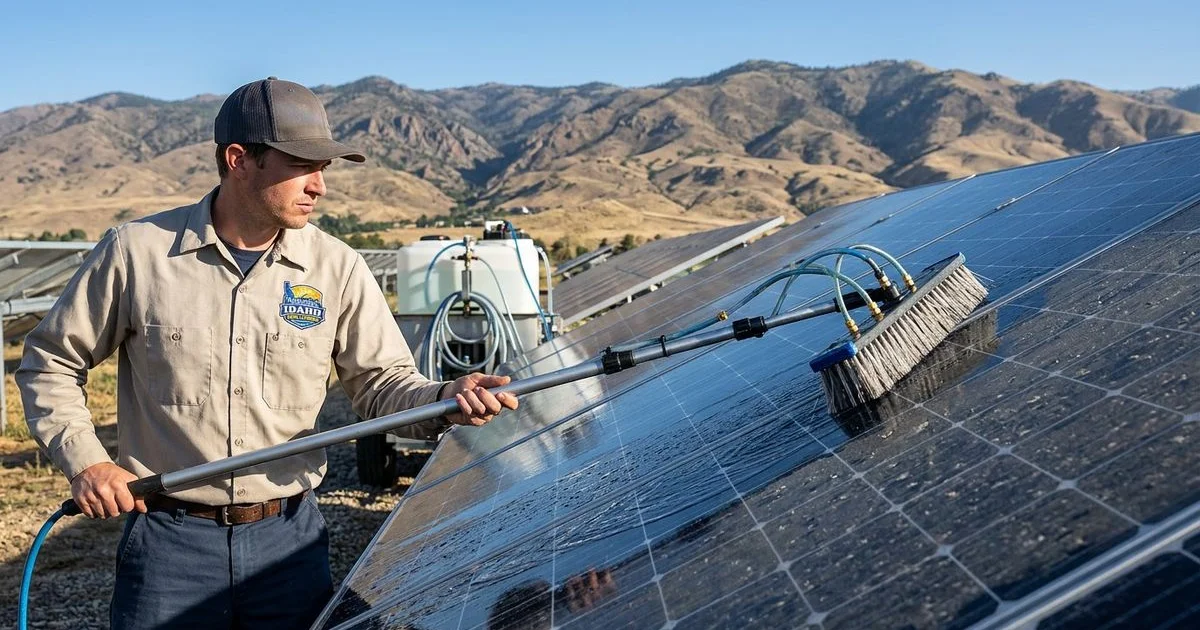
Our crews deliver this pure water using specialized carbon-fiber water-fed poles. A tool like the Tucker Solar Boost allows us to reach high rooflines safely. We combine this long reach with soft-bristle nylon brushes designed specifically for delicate photovoltaic glass.
This means purified water cleans more effectively than tap water even without adding soap or detergents. The water itself performs the cleaning by dissolving surface contaminants and suspending them in solution, then carrying them away as it flows across the panel. When any remaining water evaporates, it leaves nothing behind because there were no minerals in it to deposit.
What Hard Water Does to Solar Panels
Mineral Deposits Block Sunlight
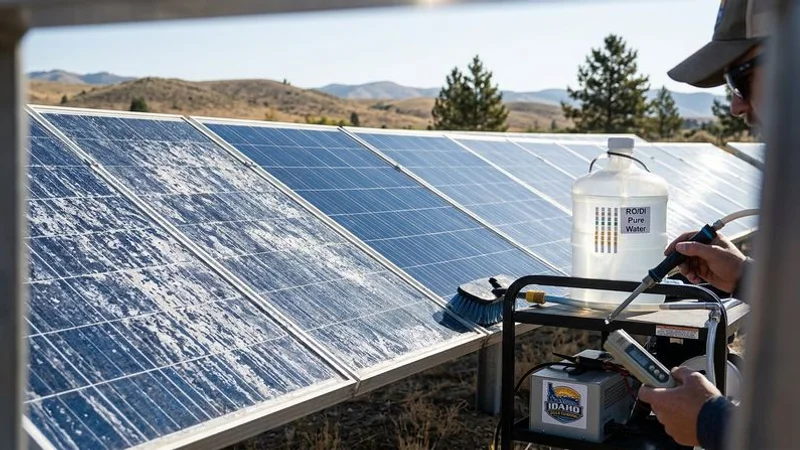
When you rinse solar panels with untreated tap water, especially the mineral-rich water found throughout Idaho, every droplet that evaporates on the glass surface leaves behind a tiny deposit. These elements include calcium carbonate, magnesium, and silica. These deposits appear as white or gray spots that are commonly called water spots, hard water stains, or mineral scale.
On a window, these deposits are merely an eyesore. On a solar panel, they are a measurable performance problem. Each mineral deposit acts as a miniature opaque barrier that prevents sunlight from reaching the photovoltaic cells underneath the glass. A single cleaning with hard tap water can leave thousands of these micro-deposits scattered across your panel surface, collectively blocking enough light to noticeably reduce energy output.
Cumulative Damage Gets Worse Over Time
The most dangerous aspect of hard water deposits on solar panels is that they accumulate with every cleaning. Each time you hose down your panels with tap water, a fresh layer of minerals is deposited on top of the previous layer. After just two or three tap water cleanings, the mineral buildup can reduce light transmission through the glass by 5 to 10 percent.
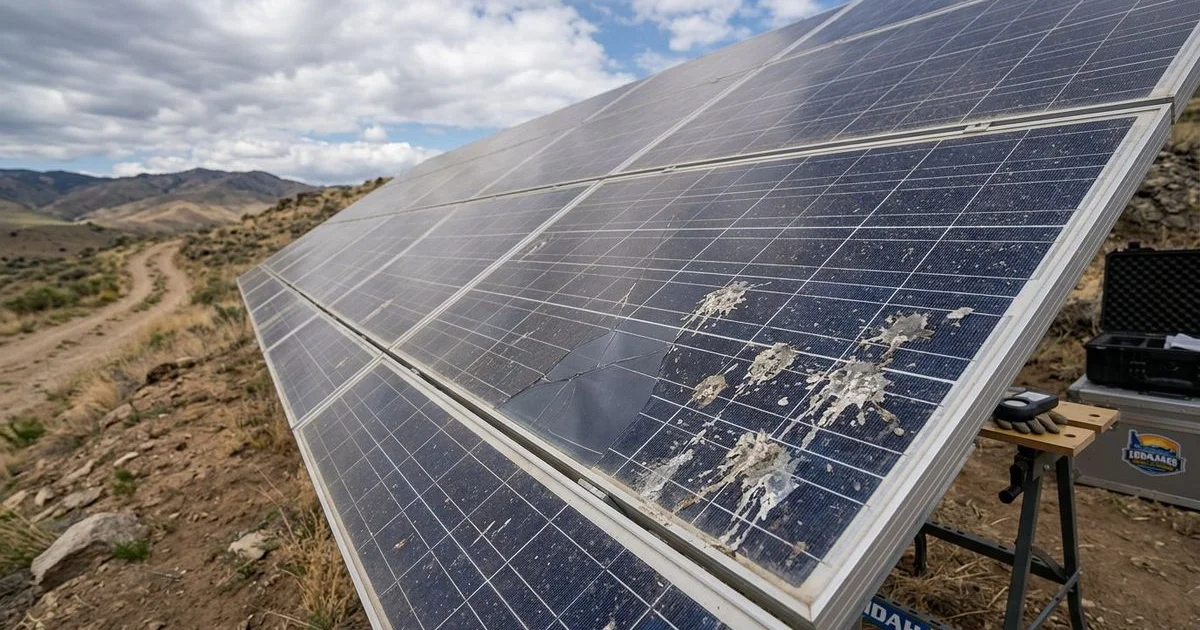
We also warn clients about the dangerous “hot-spot effect.” When dense mineral deposits or bird droppings shade localized areas, those specific cells stop generating power and instead absorb power from neighboring cells. This localized shading causes three severe problems:
- Drives temperatures up sharply.
- Accelerates cell degradation.
- Increases the risk of irreversible backsheet cracking.
After years of repeated tap water cleanings, these deposits can become so chemically bonded to the glass that removing them requires aggressive chemical treatments or abrasive methods. Both of these approaches risk permanently damaging the panel.
Anti-Reflective Coating Damage Is Permanent
Modern solar panels feature a carefully engineered anti-reflective coating (ARC) on their glass surface that boosts light absorption by reducing how much sunlight bounces away. This microscopic layer is what gives panels their characteristic dark blue or black appearance. Hard water minerals can chemically interact with this coating over time, degrading its effectiveness and permanently reducing the amount of light that reaches the cells.
Our industry data shows that a destroyed anti-reflective coating causes a permanent 15 to 20 percent loss in efficiency. Once this delicate layer is damaged by harsh scrubbing or etching, it cannot be repaired or restored.
The panel will operate below its rated efficiency for its entire remaining lifespan, which could be 20 years or more. This alone is one of the most compelling arguments for never using untreated tap water on solar panels.
Why Idaho’s Water Is Especially Problematic
Regional Water Hardness Across the Treasure Valley
Idaho consistently ranks among the states with the hardest water in the nation. The state’s underlying geology, dominated by limestone, basalt, and volcanic rock formations, means that both groundwater and surface water absorb significant quantities of dissolved minerals as they move through the earth.
We look to the United States Geological Survey (USGS) for accurate water data. The USGS notes that the average water hardness for an American home is around 128 parts per million (PPM). Idaho communities frequently blow right past that national average.
Here is a look at regional water hardness across the Treasure Valley:
- Boise area: 170 to 250 ppm TDS, classified as hard to very hard
- Meridian and Nampa: 200 to 350 ppm TDS, classified as very hard
- Eagle and Star: 180 to 300 ppm TDS, classified as hard to very hard
- Caldwell and Kuna: 250 to 400 ppm TDS, classified as very hard to extremely hard
For reference, water below 60 ppm is considered soft, and water between 61 and 120 ppm is considered only slightly hard. Nearly every community in the Treasure Valley exceeds these thresholds by a wide margin, placing Idaho among the worst states in the country for using tap water on solar panels.
The Silica Problem Unique to Idaho
Beyond the standard calcium and magnesium found in hard water nationwide, Idaho’s volcanic geology contributes elevated levels of dissolved silica. Silica deposits present a particularly serious threat because they form an extremely hard, glass-like scale that is far more resistant to removal than calcium-based deposits.
Our technicians understand that silica actually bonds chemically to the glass substrate over time. It does not just sit on the surface. Silica scale on solar panels creates a permanent haze that is nearly impossible to eliminate without using highly acidic descaling treatments. Using those harsh acids introduces a massive risk of destroying the panel’s anti-reflective coating completely.
Why Soap and Cleaning Chemicals Are Not the Answer
Some homeowners reason that if tap water leaves mineral deposits, they can compensate by adding soap or cleaning chemicals to the process. This approach introduces new problems rather than solving the mineral issue.
The Problems With Chemical Cleaners on Solar Panels
We strongly advise against using off-the-shelf household chemicals for solar maintenance. Many common glass cleaners and degreasers have uncontrolled pH levels approaching 10, which will actively corrode the anti-reflective coating on your panels. Even worse, industrial solvents or lime removers can dissolve the polymer weatherproof seals (like EVA or TPU) that keep moisture out of the panel’s delicate wiring.
Here are the specific risks of chemical cleaners:
- Soap residue attracts more dirt: Soap leaves a thin film on the glass that acts as an adhesive for dust and pollen, meaning your panels get dirty faster after a soap-based cleaning.
- Chemical damage to coatings: Many household cleaners contain ammonia, alcohol, or abrasive compounds that degrade the anti-reflective coating and attack the sealant around panel edges.
- Soap scum formation: Soap combined with hard water creates soap scum, the same chalky white film you see in your shower, which is even worse for light transmission than mineral deposits alone.
- Warranty violations: Most solar panel manufacturers explicitly prohibit chemical cleaners and will void warranties if chemical damage is found during inspection.
- Environmental runoff: Chemical cleaners washed from rooftops flow into storm drains and eventually into Idaho’s rivers and streams.
To make the best choice for your system, review this quick comparison of cleaning methods:
| Cleaning Method | Efficacy & Residue Risk | Long-Term Safety Impact |
|---|---|---|
| Hose & Tap Water | High mineral residue, creates spots | Lowers efficiency, risk of severe scaling |
| Soap & Household Chemicals | High chemical residue, attracts dust | High risk of destroying protective coatings |
| Professional RO/DI Water | Zero residue, dissolves contaminants | Maximum safety, preserves factory warranties |
No combination of soap or chemicals can compensate for the mineral content in Idaho’s water. The only reliable solution is to begin with purified water that has no minerals to leave behind.
How Professional Purified Water Cleaning Works
When our team arrives to clean your solar panels, we bring a mobile RO/DI water purification system that produces ultra-pure water on-site from your standard tap water supply.
Our Step-by-Step Process
We follow strict operational guidelines to ensure your property remains perfectly safe during maintenance. A critical part of this is managing water pressure. We keep the water pressure firmly below 40 PSI (0.5 MPa) because higher pressures can induce micro-cracks in the glass and drive water deep into the aluminum frame gaps.
Here is exactly how the service works:
- On-site water purification: We process your tap water through our multi-stage RO/DI system, reducing total dissolved solids from Idaho’s typical 200 to 400 ppm down to 0 to 5 ppm.
- Temperature adjustment: During cooler months, we gently warm the purified water to improve cleaning effectiveness while avoiding thermal shock to cold panel glass.
- Soft brush application: Purified water is delivered through specialized soft-bristle brushes that gently loosen dirt, dust, and biological matter without scratching the glass or damaging the coating.
- Thorough rinse: Additional purified water flows across the entire panel surface, carrying away all suspended contaminants safely and effectively.
- Spot-free evaporation: Because the rinse water contains zero minerals, it evaporates completely without leaving any deposits, spots, streaks, or residue.
The result is a perfectly clean panel surface that transmits maximum sunlight to the photovoltaic cells beneath. No water spots, no chemical film, no soap residue, and no mineral deposits.
Protecting Your Investment for the Long Term
Your solar panels are engineered to generate clean energy for 25 to 30 years. Using the wrong type of water to clean them progressively degrades their performance and causes irreversible damage to their specialized optical coatings. In Idaho, where municipal water hardness ranks among the highest in the nation, this risk is significantly greater than in regions with naturally softer water.
We look closely at the research provided by the National Renewable Energy Laboratory (NREL). Their 2026 data shows that high-quality solar panels naturally degrade at a slow rate of about 0.5 percent per year. But improper maintenance and heavy mineral soiling can drastically accelerate that timeline, robbing you of years of peak energy production.
“A well-maintained solar array preserves your financial investment and ensures maximum energy production for decades.”
Enrolling in a solar panel maintenance program with RO/DI purified water is not just about making your panels look clean today. It is about preserving their ability to perform at their rated capacity for their entire operational lifespan.
Every cleaning with purified water maintains the integrity of your panel glass and anti-reflective coating. Every cleaning with untreated tap water chips away at both.
Ready to see the difference purified water cleaning makes for your system?
Contact us to schedule your professional residential solar panel cleaning and experience truly spot-free results.
We bring our advanced RO/DI purification system directly to your home and leave your panels performing at their absolute best.