Our professional solar panel cleaning in Idaho service team has noticed a major shift in how summer skies look across the Treasure Valley. The thick haze settles over the region earlier each year.
We know that smoke creates a massive drag on your rooftop energy production.
It is more than just a temporary shadow. Our experts spend every fall assessing the physical damage these changing seasons leave behind on solar arrays.
Understanding how wildfire smoke affects solar panel efficiency in Idaho provides a clear roadmap to protect your investment.
How Wildfire Smoke Affects Solar Panel Efficiency in Idaho: Two Distinct Damage Types
Atmospheric Blocking: The Immediate but Temporary Effect
When smoke fills the air, it acts as a massive physical filter. We often see production drop significantly during these heavy haze events.
Recent studies from the National Renewable Energy Laboratory (NREL) show daily power losses ranging from 10 to over 40 percent based on smoke plume density. Our monitoring systems confirm similar temporary losses across Idaho installations.
The U.S. Energy Information Administration (EIA) reported regional generation drops of up to 30 percent during recent severe smoke events. We know the system will automatically return to its normal output level once skies clear. Different solar cell technologies respond differently to the spectral shift caused by smoke.
Surface Deposition: The Lingering Problem That Costs Real Money
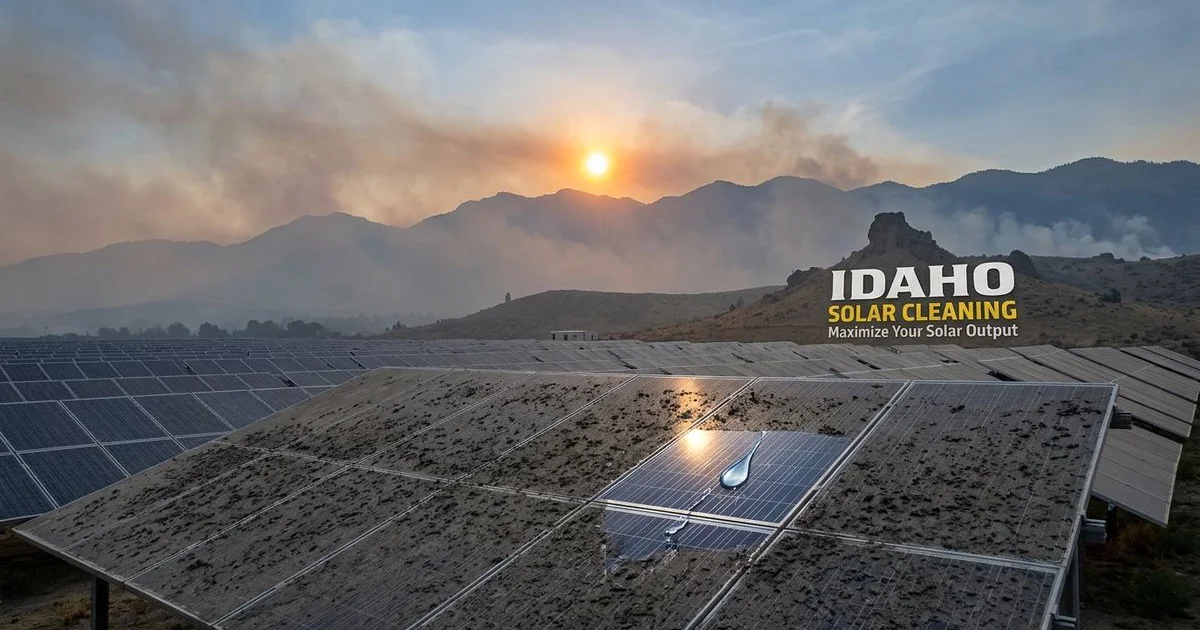
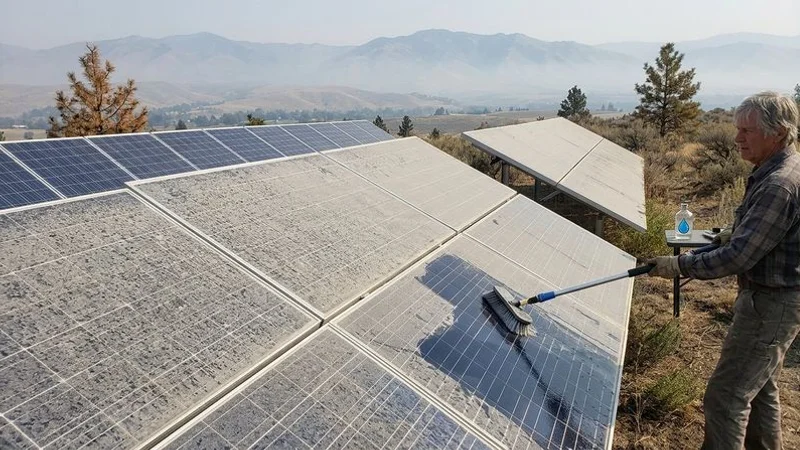
The second impact of wildfire smoke costs you real money long after the air appears to clear. We find that this surface deposition includes several highly damaging components.
- Fine carbon particles (soot) that absorb light energy
- Mineral ash from burned vegetation that creates an opaque film
- Volatile organic compounds that form a sticky binding residue
- Fine silica particles from burned soil that act like sandpaper
These deposits do not wash away with a light rain. Our field tests show post-fire surface deposits typically cause 10 to 20 percent ongoing production loss. This lingering contamination requires immediate attention.
Idaho’s Wildfire Season: A Month-by-Month Timeline
The risk of fires in Idaho usually peaks between late spring and early fall. We use this timeline to help property owners plan their seasonal maintenance.
The 2024 season was historically severe, with nearly one million acres burned and 1,450 separate wildfire incidents across the state. Our team closely monitors these shifting weather patterns. Understanding when fires threaten your specific region makes a huge difference.
June Through July: Early Season Buildup
Fire season generally begins in late June as temperatures climb and spring moisture evaporates. We tracked early incidents like the 2025 Island Creek Fire, which started in late July and quickly threatened nearby communities.
The Boise Foothills and surrounding wildland-urban interface areas face extreme vulnerability during this initial period. Our data shows early season fires tend to be smaller, but their smoke still drops solar production by 5 to 15 percent in nearby towns. A proactive approach is necessary.
August Through September: Peak Fire Season
August and September historically stand as Idaho’s worst months for wildfire activity. We watched the massive 2024 Wapiti Fire burn over 129,000 acres in Boise and Custer counties during this peak window.
The 187,000-acre Paddock Fire also contributed to severely degraded air quality and thick ash deposition during this same period. Our crews measured sustained production losses hitting 20 to 40 percent during these peak events. Thick smoke plumes can smother the Treasure Valley for weeks at a time.
October: Late Season Risks
Late-season fires generate significant smoke just as fall weather begins to set in. We warn clients that October ash poses a massive winter maintenance threat.
The 2024 Valley Fire sprouted in early October, burning nearly 10,000 acres in the foothills above Lucky Peak. Our technicians often find this residue sitting untouched and compounding with snow and mineral-laden moisture. This creates a concrete-like contamination layer that is incredibly difficult to remove in the spring.
Calculating the Real Financial Impact
Let us work through the actual cost of wildfire smoke on a typical Idaho residential solar system. We will use a conservative 12 cents per kilowatt-hour for this example, based on Idaho Power’s recent tiered residential summer rates.
This breakdown illustrates why timely post-fire cleaning is a highly profitable investment.
A Moderate Smoke Season Scenario
| Metric | Value |
|---|---|
| System Size | 8 kW residential installation |
| Normal August Production | 1,200 kWh |
| Normal September Production | 900 kWh |
| Atmospheric Loss (3-week event) | 30% average daily reduction |
| Unavoidable Energy Lost | ~300 kWh |
| Post-Smoke Surface Deposit Loss | 15% ongoing reduction |
| Total Seasonal Energy Impact | ~750 kWh |
| Estimated Financial Loss | $90 to $110 |
Surface deposit losses continue accumulating month after month until the panels receive proper cleaning. We see these numbers easily double during a severe smoke season with extended heavy haze. The financial drain extends well into the following spring if winter conditions prevent timely service.
The Compounding Multi-Year Problem
Skipping post-fire cleaning allows ash and residue to build up progressively. We regularly clean panels carrying multiple seasons of baked-on wildfire residue.
The before-and-after production difference is striking. Our post-restoration tests often reveal a 20 to 30 percent immediate improvement in output. Regular maintenance prevents this long-term degradation.
What to Do During and After Wildfire Season
Timing your response correctly is vital to protecting your equipment. We break this process down into two distinct phases. Careful monitoring prevents accidental damage.
During Active Smoke Events
Your options remain limited while smoke actively fills the air. We strongly advise monitoring the EPA AirNow index to track local conditions. Taking action during poor air quality only exposes a freshly cleaned surface to immediate re-contamination.
- Do not clean your panels while air quality is hazardous.
- Monitor your production data closely to record your exact losses.
- Watch your monitoring system for error codes triggered by extreme heat.
- Document conditions thoroughly with photos and air quality screenshots.
Documenting conditions thoroughly strengthens future insurance claims. We always tell clients to keep their monitoring systems active and watch for equipment alerts. Patience is the best strategy during this phase.
After the Smoke Clears: Act Quickly
You must address the surface deposits immediately once air quality returns to healthy levels. We recommend taking specific steps within one to two weeks after the smoke clears. Timing dictates how easily the ash comes off.
- Schedule a professional cleaning to remove soot before it bakes on.
- Request a production comparison to measure current output against the baseline.
Never attempt to wipe or scrub panels yourself with a dry brush. We know that wildfire ash contains abrasive silica particles. A gentle approach is mandatory.
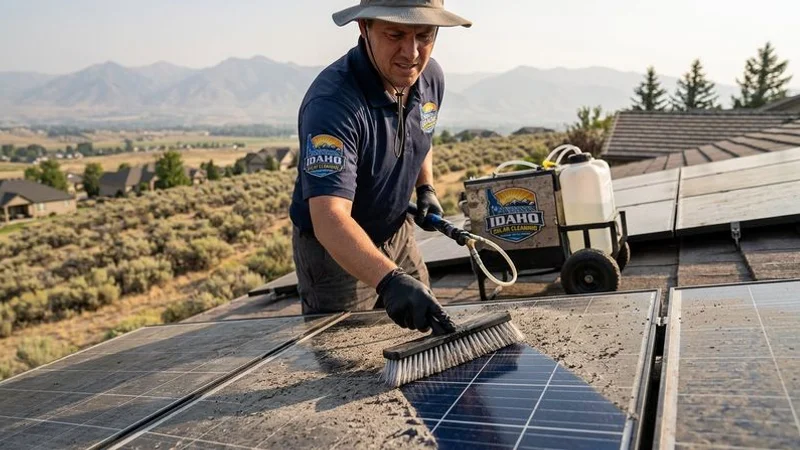
Why Professional Cleaning Is Essential After Wildfire Events
Post-wildfire cleaning requires specialized care that goes far beyond a standard seasonal spray. We see countless panels ruined by well-meaning homeowners trying to scrub away ash. The chemical and physical properties of smoke residue demand proper handling.
Abrasive Particle Hazard
Wildfire ash contains fine silica particles from burned soil. We know that silica ranks at a 7 on the Mohs hardness scale.
Typical solar panel glass sits lower on the scale, around a 5.5 to 6. Our testing confirms that wiping these particles with a cloth or sponge guarantees micro-scratches that permanently reduce light transmission. Professional equipment uses low-pressure purified water to float particles off safely.
Chemical Residue Complexity
Smoke from fires burning through developed areas or forests leaves behind dangerous chemical compounds. We frequently find wood ash containing high levels of potassium and calcium.
These minerals mix with morning dew to create a highly alkaline, corrosive residue. Our professional technicians use specialized pure water systems to neutralize and lift these elements without damaging your panel seals. Chemical damage voids many manufacturer warranties.
Comprehensive System Assessment
Your panels endure prolonged stress during a multi-week smoke and heat event. Our service teams perform a thorough inspection alongside every post-fire cleaning.
Technicians use thermal imaging tools to check for hotspots indicating damaged bypass diodes. We also verify that extreme temperatures did not warp your mounting hardware or degrade critical wiring connections. This proactive check ensures long-term system stability.
Building Wildfire Season Into Your Annual Maintenance Plan
Idaho property owners must incorporate post-fire maintenance into their standard annual budget. We created this schedule to help you maximize your solar savings year-round. Waiting for a noticeable drop in power usually means you have already lost significant money.
Recommended Annual Maintenance Schedule
| Season | Recommended Action | Purpose |
|---|---|---|
| Spring (April/May) | Seasonal Preparation Cleaning | Maximize peak summer production |
| Mid-Summer (July) | Production Data Review | Assess performance before fires |
| Fall (Sept/Oct) | Post-Fire Professional Cleaning | Remove accumulated smoke residue |
| Late Fall (Nov) | Comprehensive System Inspection | Check hardware before winter snow |
Budget for Post-Fire Service
You should include the cost of a post-fire cleaning in your annual financial calculations. We typically see professional cleanings offset their own cost through immediately restored energy production.
A dedicated fall cleaning prevents months of compounding losses during the crucial winter window. Our standard maintenance plans simplify this budgeting process. Planning ahead removes the stress of unexpected expenses.
Consider Enhanced Protection for High-Risk Properties
Properties near the wildland-urban interface face much higher risks of heavy smoke concentration. We advise owners in high-risk areas like Boise County or Custer County to schedule more frequent cleanings.
The cost of one additional mid-season service is minimal compared to the heavy energy losses caused by carrying ash deposits through August and September. Our crews can assess your specific property risk during a routine visit. Customized protection ensures maximum efficiency.
Protect Your Solar Panels From Idaho’s Wildfire Seasons
Wildfire smoke is a permanent part of the local climate. We know that understanding how wildfire smoke affects solar panel efficiency in Idaho gives you the power to respond.
Do not let baked-on ash silently erode your return on investment. Our crews use advanced purified water systems to safely strip away corrosive soot without scratching your glass.
Schedule your targeted post-fire restoration today. We want your system producing at its absolute maximum capacity heading into the dark winter months.
Learn exactly how to protect your investment by visiting our residential solar panel cleaning services page to book your fall maintenance.